Festivals
✍️ Restaurantsoman.com 📅 August 19, 2026 🕒 Last verified: August 19, 2026
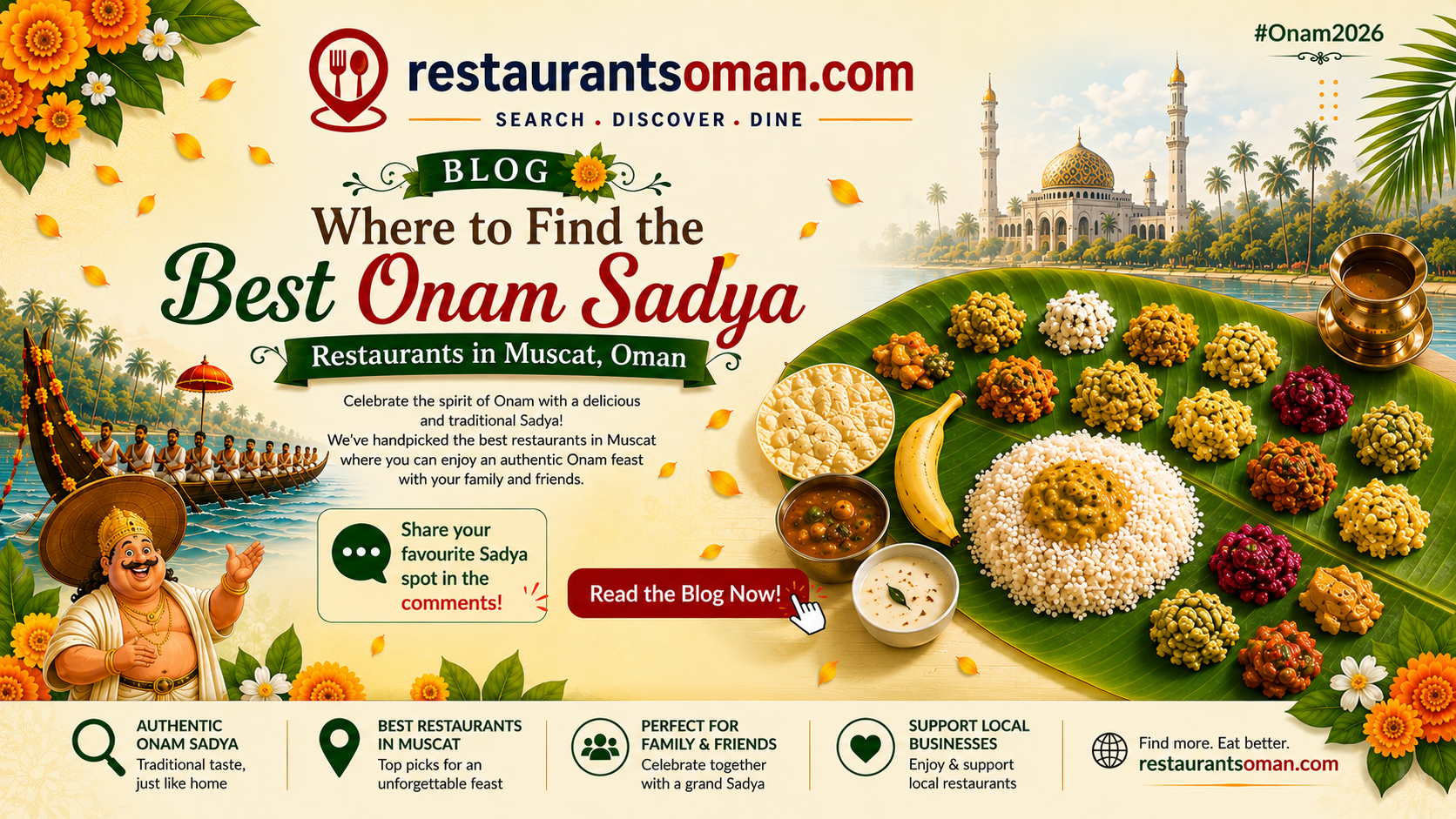
Muscat — Every year, as Onam approaches, kitchens across Kerala — and Malayali homes across Oman — come alive with the fragrance of coconut, curry leaves, and freshly steamed rice. At the center of it all sits the Sadya: a grand vegetarian feast served on a banana leaf, with over two dozen dishes arranged in a precise, time-honored order. But the Onam Sadya isn't just an elaborate meal — every element carries centuries of meaning. Below, we look at the history of the festival, the traditions behind the feast, and where to find an authentic Onam Sadya in Oman this year.
Onam is Kerala's biggest and most beloved festival, celebrated with equal enthusiasm by people of all faiths across the state. It falls during the Malayalam month of Chingam (usually August–September) and marks the traditional Malayali New Year and the annual rice harvest.
At the heart of Onam is a legend rooted in Hindu mythology. The festival honors the mythical King Mahabali, a benevolent and much-loved asura (demon) king whose reign was considered a golden age of prosperity, equality, and happiness. Under his rule, there was said to be no poverty, deceit, or suffering — everyone lived in harmony and abundance.
Threatened by Mahabali's growing power, the god Vishnu took the form of Vamana, a humble dwarf Brahmin, and approached the king asking for a small piece of land — as much as he could cover in three steps. Mahabali, known for his generosity, agreed. Vamana then grew to a cosmic size: with his first step he covered the earth, and with his second, the heavens. With nowhere left for the third step, Mahabali offered his own head, and Vishnu's foot sent him down to the netherworld.
Moved by the king's humility, Vishnu granted Mahabali one wish — to return to Kerala once every year to visit the people he loved and ruled so justly. Onam celebrates that homecoming. Legend holds that Mahabali returns each year to see his subjects thriving, and Malayalis welcome him with their homes, streets, and hearts decorated and ready.
The festival unfolds over ten days, culminating in Thiru Onam, the most important day. Celebrations include:
Onam is as much about community and gratitude as it is about feasting — a time to celebrate the harvest, honor tradition, and welcome guests with the same generosity Mahabali himself was known for. Nowhere is that spirit of hospitality more visible than in the Sadya.
Long before stainless steel and ceramic became kitchen staples, banana leaves were the natural choice for serving food — and the tradition has endured for a reason. Banana leaves are naturally biodegradable, hygienic, and require no washing or waste. Beyond the practical, they carry symbolic weight too: serving a meal on a banana leaf is a gesture of prosperity, abundance, and hospitality.
No Sadya feels complete without the satisfying crunch of a pappadam. Its crisp texture offsets the softness of rice and the richness of curries, adding contrast and completing the meal from the first bite to the last.
As the Sadya winds down, a small piece of jaggery-sweetened banana or another treat appears near the final courses. Ending a meal with something sweet symbolizes celebration, completeness, and a wish for happiness for everyone at the table.
And then comes the payasam — the true finale. Rich, warm, and often studded with cashews, payasam is traditionally the ceremonial closing dish of the Sadya, representing gratitude for the harvest, abundance for the year ahead, and a sweet ending to the celebration.
Ranked alphabetically by area, based on Google review data as of August 2026. Hours, prices, and Sadya availability can change during the Onam season, so it's worth calling ahead to confirm bookings.
Sohar
Kahani has quickly become one of Sohar's most-loved dining spots, known for its cozy ambiance, toddler-friendly setting, and a private dining hall ideal for family gatherings and festival bookings. Guests consistently praise the warm service and standout sweets, including a well-reviewed jilebi.
Ruwi, Muscat
Ananthapuri is widely regarded as one of the most authentic Kerala restaurants in Muscat, with décor and atmosphere that reviewers say genuinely transport diners back home. The coconut-based curries and overall spice balance draw consistent praise, along with attentive, welcoming staff.
Al Khuwair, Muscat
Foodlands is a Muscat institution for Malabar biriyani and full Kerala meals, with one of the highest review counts on this list. It gets especially busy on Fridays and Saturdays, so arriving by early afternoon is recommended to avoid missing out on the biriyani.
Al Khuwair, Muscat
Imperial Kitchen is a popular buffet-style restaurant known for variety — Indian, Chinese, and Thai dishes alongside Kerala specialties. It's a frequent choice for celebrations and larger group gatherings, and can get busy on weekends, so calling ahead for a table is a good idea.
Ruwi, Muscat
Kozhikodens leans into Malabar-style cooking, with reviewers highlighting the fish-and-mango curry, Kerala-style biriyani, and a well-loved vermicelli payasam for dessert. It's also a good stop for Kerala tea and snacks outside of full meal times.
Rex Road, Ruwi, Muscat
Aagraham is a go-to spot for authentic Kerala breakfast and lunch — puttu, idiyappam with egg roast, parotta with beef curry, and kadala curry all get regular mentions. Reviewers consistently praise the consistency of the food and the hospitality of the staff, even during busy weekend hours.
Al Ghubrah, Muscat
Foodbook offers a casual, family-friendly Kerala and Indian dining experience with generous portion sizes. It's especially popular for grilled dishes and Kerala parotta, though a few recent reviews note some inconsistency in food quality compared to its earlier years — worth keeping in mind when planning a visit.
Ruwi, Muscat
MRA is known for its dum biryani, Chicken Madbhi, and standout desserts, alongside a full in-house bakery counter. It's praised for being affordable, clean, and well-presented — a solid choice for both sit-down meals and festive takeaway orders.
South Mabelah, Seeb
Malabar Days serves Kerala meals alongside North Indian, Chinese, and Thai dishes, with Payoli chicken, king fish fry, and pazham pori among the most-mentioned items. It's also well known locally for one of the better cups of Malabar chai in the area, though a few reviewers note the flavor can be inconsistent between visits.
Al Ghubrah, Muscat
Set in a heritage-inspired interior celebrating Indian history, 1947 is best known for its non-veg thali, parata, and butter chicken. It's a popular lunch destination, so midday visits can get busy — reservations are recommended for groups.
Al Khuwair, Muscat
Queens Palace is known for authentic biriyani, fresh salads, and Kerala meals in a cozy setting with ample parking. It's a favorite for family dinners and casual group outings, and now has a dedicated party hall available for larger festival bookings.
Multiple branches: Al Hail, Azaiba, Ghala, Muscat
Tely is a well-loved multi-cuisine chain specializing in Malabari dishes — Pidi Kozhi, Chicken Madhooth, and Kerala-style biriyani are recurring favorites across branches. It's known for reasonable prices and a relaxed, welcoming ambiance, with the Al Hail branch drawing particular praise for its spacious, family-friendly layout.
Al Ghubrah & Al Khuwair, Muscat
Nisars Adukkala is known for hearty, homestyle Kerala food — appam with egg curry, puttu with kadala curry, and beef biriyani — plus affordable monthly meal plans that make it popular with the local community. Spacious seating makes it practical for families, though parking can be tight during peak hours.
Onam season is one of the busiest times of year for Kerala restaurants in Oman, and several of the spots above offer special Sadya menus or set feasts during the festival window — it's worth calling ahead to check availability and book a table, especially for larger family or community gatherings. Restaurants with dedicated party halls or banquet spaces (Kahani, Imperial Kitchen, Queens Palace) are a good option for bigger groups celebrating together. Whichever spot you choose, the spirit of the Sadya — gratitude, abundance, and togetherness — is the same wherever it's served.